
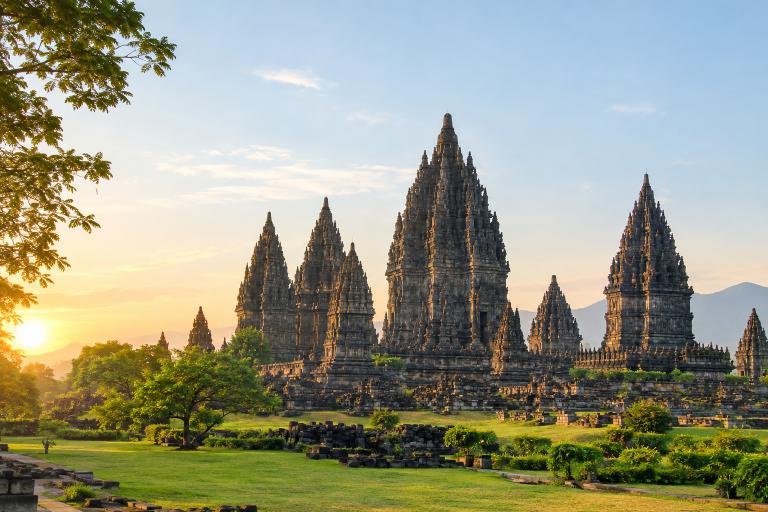
Prambanan Temple is not only a magnificent ancient monument but also an ongoing conservation project. Its history includes decline, abandonment, rediscovery, and decades of careful restoration. For anyone interested in Prambanan temple restoration, the story shows how experts work to protect one of Indonesia’s most important heritage sites.
Prambanan was built during the 9th and 10th centuries under the Mataram Kingdom. It was designed as a major center of Hindu worship and dedicated to the Trimurti: Shiva, Vishnu, and Brahma. The central Shiva Temple is the tallest structure in the complex, reaching approximately 47 meters. Its towering form dominates the landscape and serves as the spiritual center of the site.
The complex contains hundreds of temples arranged in concentric zones. The most sacred structures are placed at the center, while smaller shrines surround them. This layout reflects Hindu cosmology and demonstrates the advanced planning skills of ancient Javanese builders.
The temple complex faced many challenges throughout its history. Earthquakes, volcanic eruptions, and political changes contributed to its decline in the early 11th century. Many structures collapsed, and the site was eventually abandoned. Over time, vegetation covered much of the area, and the temples remained hidden for centuries.
The complex was rediscovered in the 17th century, but major restoration efforts came much later. Restoring Prambanan has been a difficult process because many original stones were damaged, scattered, or lost. Experts have worked carefully to return the stones to their correct positions while preserving the historical authenticity of the site.
One of the most significant restoration challenges came after the 2006 Yogyakarta earthquake. The earthquake caused serious damage to several structures, shifting stones and weakening parts of the complex. Indonesian and international experts conducted structural surveys and restoration planning to protect the remaining heritage.
Restoration work at Prambanan requires a careful balance between preservation and reconstruction. Experts must study the original design, identify the correct position of each stone, and use appropriate techniques to maintain historical authenticity. This process can take years and involves collaboration between archaeologists, engineers, and conservation specialists.
The walls of the main temples are decorated with detailed reliefs from the Ramayana epic. These carvings tell the story of Prince Rama, his wife Sita, and the monkey hero Hanuman. Protecting these reliefs is an important part of the restoration effort, as they are considered masterpieces of Hindu-Javanese art.
Prambanan is also known as Candi Roro Jonggrang. This name comes from a famous Javanese legend about a princess who was turned into stone. According to the story, a prince was challenged to build one thousand temples in one night. The princess tried to stop him by creating the illusion of dawn, and as punishment, she was transformed into stone.
In 1991, Prambanan Temple Compounds was recognized as a UNESCO World Heritage Site. This status highlights the temple’s exceptional architectural value and cultural significance. The recognition also covers nearby temple complexes such as Sewu, Lumbung, and Bubrah. The presence of both Hindu and Buddhist monuments in the same area shows the religious diversity of ancient Java.
Prambanan is located about 17 kilometers northeast of Yogyakarta city center, making it easy to reach for travelers. The site can be combined with other major attractions such as Borobudur, Sultan Palace, Malioboro Street, and Mount Merapi.
Prambanan is more than an ancient monument. It is a living symbol of Indonesia’s history, creativity, and spiritual heritage. Its restoration story, towering temples, and sacred atmosphere make it one of the most important cultural sites in Southeast Asia.
