
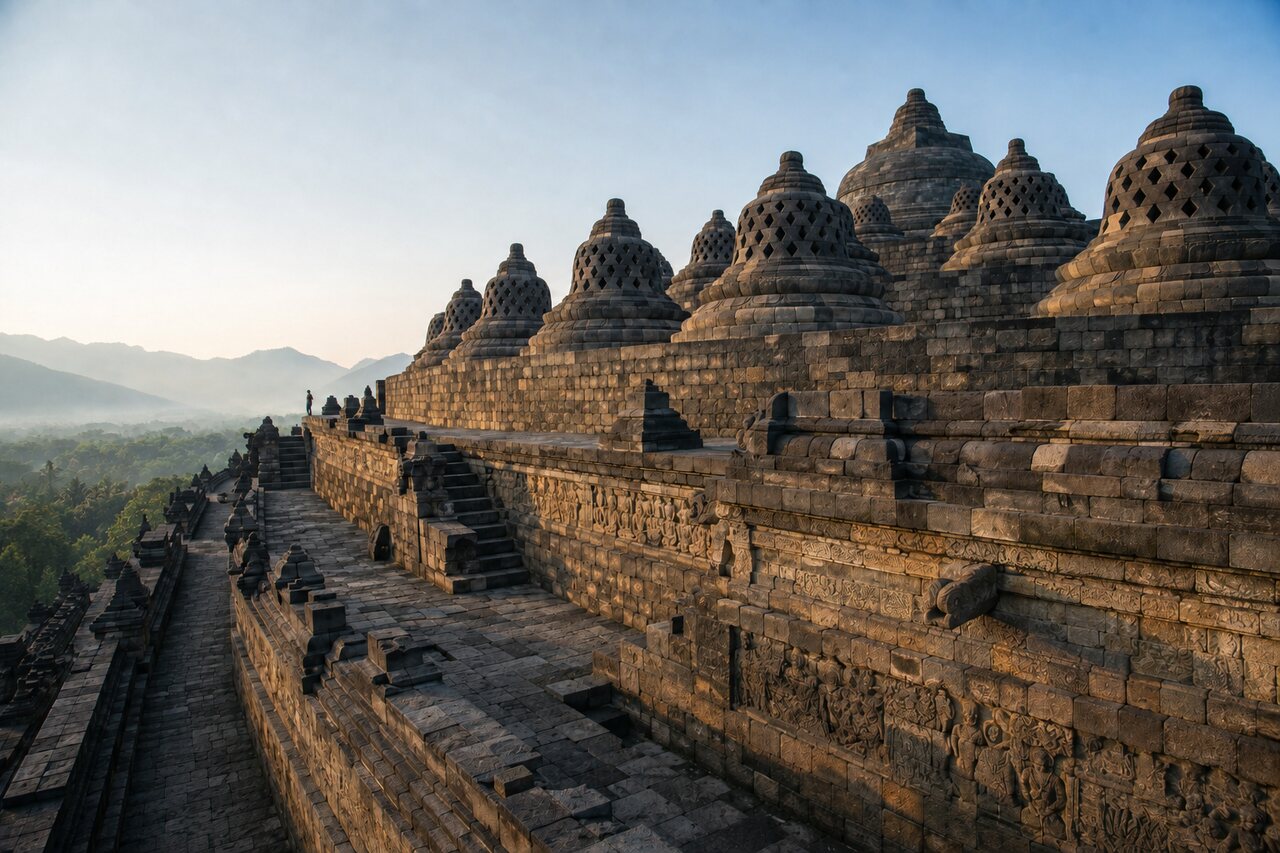
A Borobudur Ancient Architecture Facts guide reveals the remarkable design, engineering knowledge, and symbolic meaning behind one of the world’s most impressive Buddhist monuments. Borobudur represents the extraordinary ability of ancient Javanese builders to combine architecture, religion, and artistic expression.
Many travelers visit Borobudur to admire its size and beauty. However, the architectural details behind the temple reveal deeper stories about ancient technology, Buddhist philosophy, and cultural development.
For travelers aged 25 and above, understanding Borobudur’s architecture creates a more meaningful experience. Every stone, terrace, and carving represents knowledge passed down from an advanced civilization.
The Architectural Concept of Borobudur
The Borobudur Ancient Architecture Facts begin with the unique concept behind the monument.
Borobudur was constructed during the Sailendra Dynasty around the 8th and 9th centuries. The temple follows a mandala design that represents the Buddhist view of the universe.
Unlike traditional buildings with enclosed rooms, Borobudur creates a spiritual journey through open terraces and pathways.
Visitors move upward through different sections while discovering symbolic meanings behind the structure.
This design transforms architecture into a physical representation of Buddhist teachings.
Travelers can explore more about Borobudur’s history, architecture, and cultural significance through this complete guide to Borobudur Temple facts, history, architecture, and culture.
A Monument Built With Ancient Engineering Skills
One of the most fascinating facts about Borobudur architecture is the construction method.
Ancient craftsmen built the monument using millions of volcanic stone blocks without modern equipment.
They carefully shaped and arranged each stone to create a strong and balanced structure.
The builders used precise calculations to maintain symmetry throughout the monument.
Furthermore, the construction demonstrates advanced knowledge of materials, environmental conditions, and architectural planning.
The survival of Borobudur for more than a thousand years shows the success of these ancient techniques.
The Three Symbolic Levels of Architecture
Borobudur’s architecture contains three important sections that represent different stages of Buddhist philosophy.
The first level, Kamadhatu, represents the world of human desires and daily experiences.
The second level, Rupadhatu, represents awareness and the process of overcoming worldly attachments.
The highest level, Arupadhatu, represents spiritual freedom and enlightenment.
Each section provides a different experience for visitors.
The movement from the lower terraces to the upper levels creates a symbolic journey toward greater understanding.
The Role of Stupas in Borobudur Design
The stupas are among the most recognizable architectural elements of Borobudur.
The upper terraces contain seventy-two smaller stupas surrounding the central dome.
Each stupa represents spiritual achievement and Buddhist teachings.
The arrangement creates balance between artistic beauty and religious symbolism.
Moreover, the central dome becomes the highest point of the monument, representing the final stage of spiritual development.
Relief Panels as Architectural Elements
Borobudur’s architecture is closely connected with its relief panels.
Thousands of carvings cover the temple walls and communicate Buddhist stories, moral lessons, and ancient Javanese culture.
The reliefs are not only decorations but also important parts of the monument’s educational purpose.
They allow visitors to understand history through visual storytelling.
Preserving an Architectural Masterpiece
Over centuries, Borobudur experienced challenges from weather, volcanic activity, and natural erosion.
Restoration programs have helped protect the structure and maintain its historical value.
Today, visitors can experience the architectural beauty of Borobudur because of continuous preservation efforts.
Discover Borobudur Through Architectural Exploration
Exploring Borobudur with deeper knowledge creates a more valuable journey.
Local guides explain the meaning behind the design, construction methods, and artistic details.
Travelers who want a comfortable cultural journey can explore professional Yogyakarta tour services with local guides and customized travel experiences.
Experience the Genius of Ancient Architecture
A Borobudur Ancient Architecture Facts journey reveals how ancient builders created a monument that combines science, spirituality, and artistic excellence.
Borobudur remains one of the greatest examples of ancient architectural achievement.
Plan your Yogyakarta adventure and discover the incredible design secrets of Borobudur Temple.
