
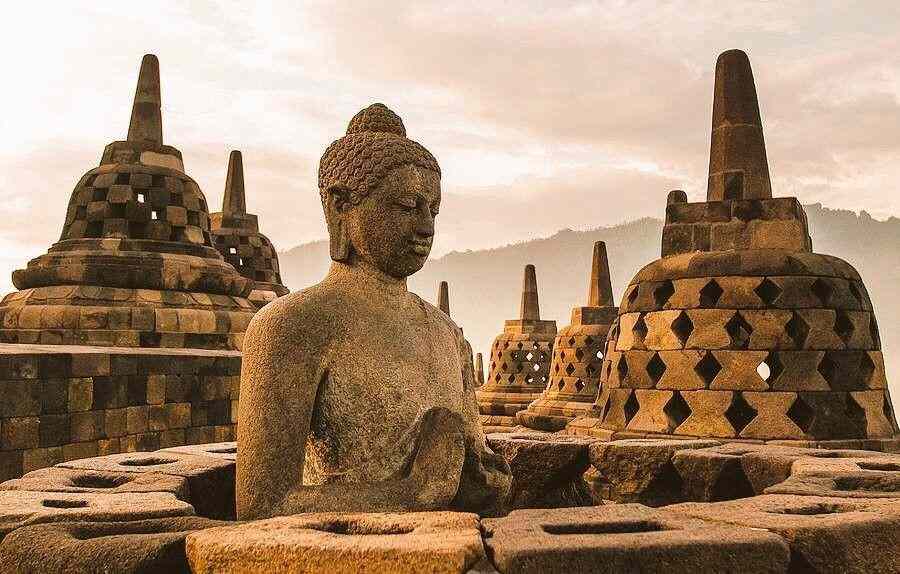
The Borobudur temple terraces are a defining feature of this remarkable Buddhist monument in Central Java. Rising gradually from the lower base toward the central stupa, the terraces create a distinctive stepped structure. Each level has different architectural details, making the journey upward an important part of the Borobudur experience.
Understanding the Borobudur Terraces
The terraces form the main body of Borobudur’s architectural structure. The lower and middle sections consist of square terraces, while the upper portion transitions into circular platforms.
This change in shape gives the monument its recognizable appearance. It also creates a gradual visual transition from detailed stone galleries to the simpler forms of the upper levels.
The terraces are connected by stairways, allowing visitors to move between different sections of the monument.
Square Terraces and Relief Galleries
The square terraces contain long gallery pathways surrounded by decorated stone walls. These walls feature numerous relief panels depicting Buddhist stories, people, animals, buildings, and other scenes.
Walking around the terraces allows visitors to experience these carvings from close range. The reliefs are arranged along the pathways, turning the terraces into an extensive visual narrative.
Buddha statues are also positioned within niches along sections of the square terraces. Their repeated arrangement contributes to the architectural balance of the galleries.
Moving From One Terrace to Another
Stairways provide the main connection between the different terraces. As visitors climb, they encounter changing perspectives of the monument.
The lower galleries feel more enclosed because of their surrounding walls and extensive carvings. Higher up, the architecture gradually becomes more open.
This progression makes the physical act of climbing an important part of the experience. Visitors do not simply observe Borobudur; they move through its architectural sequence.
For a broader explanation of the monument’s structure, reliefs, and upper platforms, this Borobudur inside guide provides additional context.
The Circular Terraces at the Top
Above the square galleries are three circular platforms. Their appearance differs significantly from the lower terraces.
Instead of extensive relief-covered walls, these platforms feature rows of perforated stupas arranged around the central stupa. The open layout provides wider views of the surrounding landscape.
The circular design also creates a strong visual contrast with the square terraces below. Together, these different forms create Borobudur’s distinctive architectural progression.
Symbolism of the Terraces
The Borobudur temple terraces are commonly connected with Buddhist cosmology. The monument’s three major architectural zones are traditionally associated with Kamadhatu, Rupadhatu, and Arupadhatu.
The detailed lower sections represent the world of form and desire, while the upper circular platforms represent a transition toward the formless realm.
This interpretation gives the terraces a symbolic role beyond their structural function. The upward movement through the monument can be understood as a representation of spiritual progression.
What to Observe During a Visit
Visitors can appreciate the terraces by paying attention to how their architectural character changes at different heights. Notice the detailed reliefs in the lower galleries, the Buddha statues within the niches, and the transition toward the open circular platforms.
The changing views are another important feature. From higher terraces, visitors can see more of the surrounding landscape while experiencing a different perspective of Borobudur itself.
Travelers interested in exploring Borobudur and other cultural attractions in Central Java can discover more through Borobudur Tours.
The Borobudur temple terraces show how architecture, movement, artwork, and symbolism can work together. Exploring each level carefully allows visitors to appreciate the monument’s layered design and the remarkable craftsmanship behind it.
