
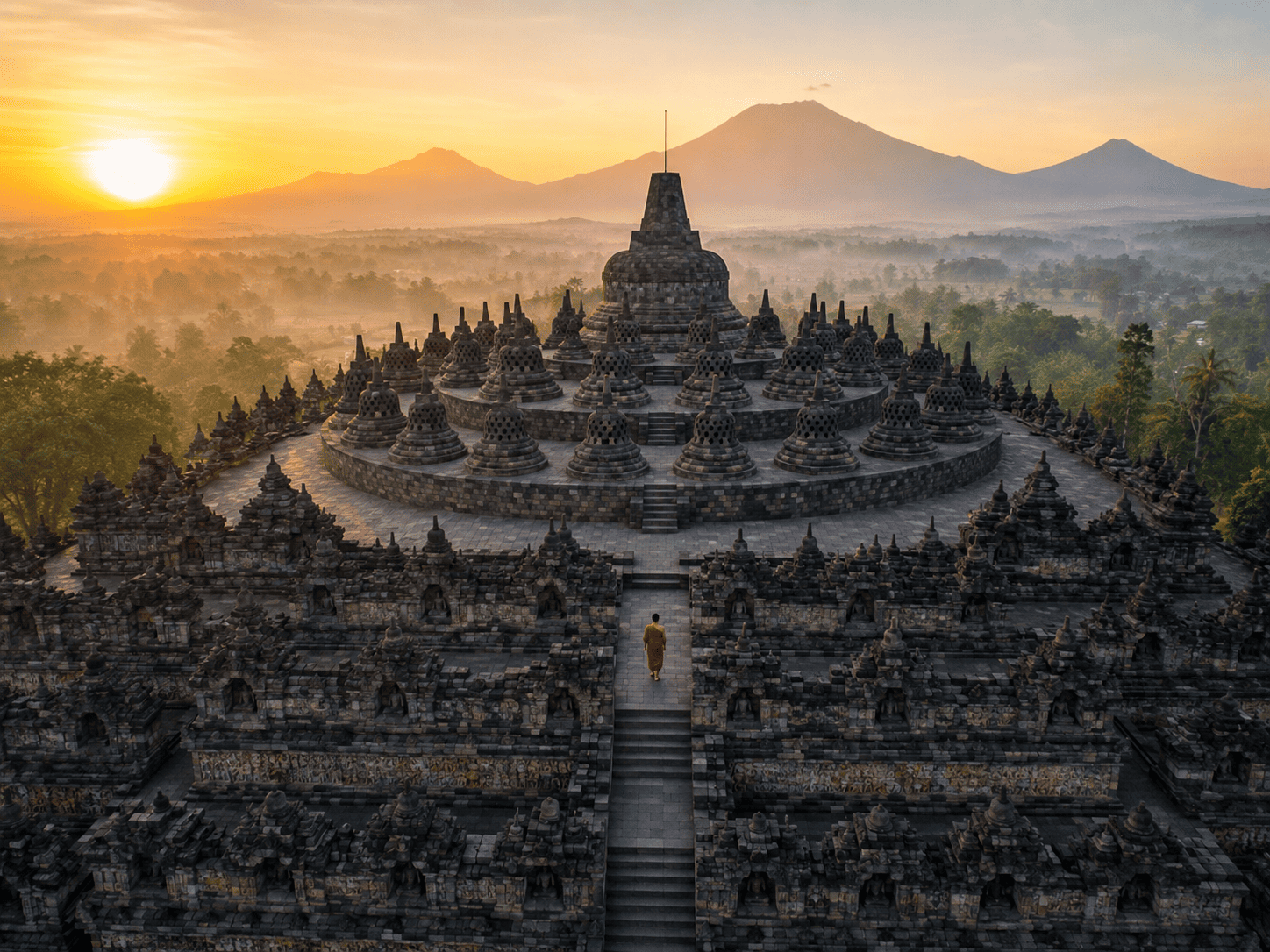
The Borobudur Temple Levels Meaning becomes clearer when you see the monument as a symbolic path rather than a simple staircase. Borobudur uses its base, square terraces, circular platforms, reliefs, and stupas to represent stages in Buddhist cosmology. As visitors move upward, the architecture changes and the spiritual message becomes more focused.
The Three Main Levels of Borobudur
UNESCO explains Borobudur through three main realms: Kamadhatu, Rupadhatu, and Arupadhatu. Each realm connects with a different architectural section.
Kamadhatu represents the realm of desire. The base of the monument expresses this stage. It reflects human life while desires, attachments, and worldly actions still influence the individual.
Rupadhatu represents the realm of form. Five square terraces create this middle section. Here, a person has started to move beyond desire but still remains connected to name, shape, and physical existence.
Arupadhatu represents the realm of formlessness. Three circular platforms and the large central stupa form this highest section. The design becomes more open, quiet, and simple.
Why Do the Levels Look Different?
The changing architecture helps visitors understand the meaning of each realm. Lower sections contain walls, narrative reliefs, niches, and many carved figures. These details create a visually rich environment.
As visitors climb, the layout gradually becomes less complex. Square terraces give way to circular platforms. Open space, repeating stupas, and wider views replace dense visual stories.
This transition supports the idea of spiritual progress. The monument moves from worldly complexity toward greater simplicity.
For a broader explanation of the monument, read our guide to facts about Borobudur Temple. It covers Borobudur’s history, architecture, Buddhist meaning, and important details.
Kamadhatu: The World of Desire
Kamadhatu connects with human actions and their consequences. Reliefs at the hidden foot include Karmawibhangga scenes that illustrate moral cause and effect.
This level reminds visitors that desire and behavior shape human experience. It forms the starting point of the symbolic journey.
Rupadhatu: The World of Form
Rupadhatu occupies the five square terraces above the base. These galleries contain many narrative reliefs and Buddha images.
Visitors walk around the terraces while following Buddhist stories and teachings. The physical route encourages reflection before moving higher. The architecture still uses strong forms, but the journey already points toward spiritual development.
Arupadhatu: The Formless Realm
Arupadhatu changes the atmosphere dramatically. Three circular terraces contain 72 openwork stupas, each with a Buddha image. A large central stupa crowns the monument.
The circular plan, repeated forms, and open space create a calmer setting. This section represents the realm where name and form no longer define existence.
How to Experience the Levels During Your Visit
Do not rush directly to the upper terraces. Start from the lower areas and observe how the architecture changes as you climb.
A local guide can explain how each section connects with Buddhist cosmology. Travelers who want deeper context can choose a private Borobudur tour from Yogyakarta.
Take time to notice the shift from detailed galleries to open circular platforms. That change forms one of the clearest expressions of Borobudur’s spiritual design.
Conclusion
The Borobudur Temple Levels Meaning comes from the connection between architecture and Buddhist cosmology. Kamadhatu represents desire, Rupadhatu represents form, and Arupadhatu represents formlessness.
Together, these levels create a symbolic upward journey. Once you understand their meaning, Borobudur becomes more than a monumental temple. It becomes a carefully structured path that uses stone, movement, and space to express spiritual progress.
